
Finance teams are under relentless pressure to close faster, improve accuracy, strengthen controls, and deliver strategic insights, all while managing growing volumes of data. This post looks at how AI-powered Sage Intacct and Sage Copilot goes beyond traditional automation with purpose-built AI designed specifically for finance:
What is AI-Powered Sage Intacct and Copilot?
Powered by Ai and Copilot, Sage Ai features embedded workflows, assistants and fully autonomous Agents that operate within customer-set permission boundaries. Instead of generic AI tools, Sage has embedded AI directly into financial workflows, enabling finance teams to automate routine manual work, make more informed decisions quickly, while maintaining full control over all financial processes.
Sage Intacct AI consists of AI-powered and automation-driven capabilities embedded directly within Sage Intacct.
Finance teams can use this to automate routine manual processes, identify anomalies, speed up close cycles and gain deeper insights into financial data aiding decision-making.
At the centre of this experience is Sage Copilot, an AI-powered finance assistant that works within Sage Intacct and helps users interact with financial information using natural language, proactive insights, and workflow-driven recommendations.
Unlike general-purpose AI tools, Sage AI is specifically designed for accounting and finance operations, with a focus on accuracy, governance, compliance, and operational control.

The Five Principles of Sage AI
For finance leaders, trust is paramount when embracing AI adoption.
Sage has built Copilot with a secure-by-design approach that respects existing authentication methods, user roles, permissions, and audit requirements. Access is governed by the same security framework used within Sage Intacct, helping ensure that sensitive financial information remains protected.
This combination of governance, transparency, and role-based access is particularly important for CFOs, controllers, and finance teams operating in regulated environments.
The 5 key principles are:
1. PROVEN
Finance teams require technology they can trust. Sage AI is directly built into the Sage ecosystem and leverages financial data, workflows, and controls already used by organisations worldwide.
Its capabilities are focused on real business outcomes such as faster close processes, improved variance analysis, AP automation, and anomaly detection.

2. FINANCE-SPECIFIC
Generic AI can struggle with accounting terminology, compliance requirements, and financial context. Sage Copilot is designed specifically for finance, understanding ledgers, subledgers, purchasing, receivables, approvals, budgets, and financial reporting.
This finance-first approach helps ensure responses and recommendations are relevant, accurate, and aligned with accounting practices.

3. IN-WORKFLOW
One of the biggest advantages of Sage Copilot is that it operates where finance teams already work. Users can access AI directly within
Sage Intacct rather than switching between multiple applications or external AI tools. Copilot surfaces insights, recommendations, reports, and suggested actions inside the platform itself.

4. PERMISSION-CONTROLLED
Financial data requires strict governance. Sage AI respects existing user permissions, roles, security policies, and access controls.
Users only see data they are already authorised to access, supporting compliance and maintaining financial integrity.

5. HUMAN-FIRST
Sage AI is designed to support finance professionals, not replace them. It helps surface insights, identify exceptions, draft actions, and automate repetitive tasks, while keeping humans responsible for approvals, decisions, and oversight.
This human-in-the-loop approach provides both efficiency and accountability.

What can Sage Copilot do for Finance Teams?
Sage AI and Sage Copilot are designed to help finance teams work smarter by bringing artificial intelligence directly into their day-to-day workflows. Rather than replacing finance professionals, these AI-powered capabilities automate routine tasks, surface valuable insights, and provide intelligent recommendations that help users make faster, more informed decisions. By analysing financial data in real time, Sage AI can identify trends, highlight anomalies, and support forecasting, enabling organisations to move from reactive reporting to proactive financial management.
Some of the most useful aspects include:
Conversational Finance Assistance
Users can ask questions in natural language and receive answers related to financial performance, variances, balances, transactions, and operational metrics. This eliminates time spent searching through reports and dashboards.
Users can ask things like:
- What budget variances require attention this month?
- Which customers have overdue invoices?
- Show me cash flow trends by entity.
- What caused the increase in operating expenses?

Automated Financial Insights

Sage Copilot continuously monitors financial information and proactively surfaces insights that may require attention. Rather than waiting for users to discover issues manually, the system highlights trends, exceptions, and opportunities.
Benefits include:
- Earlier risk identification
- Improved financial visibility
- Faster issue resolution
- More proactive decision-making
General Ledger Outlier Detection
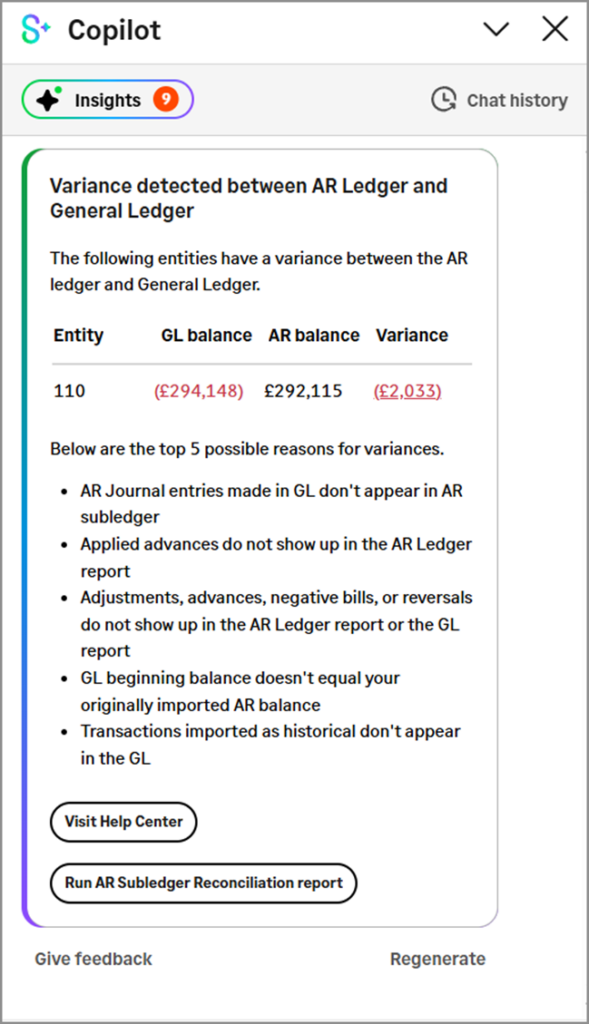
AI-powered outlier detection automatically reviews journal entries and highlights unusual transactions that may warrant additional review. This helps strengthen controls while reducing the effort required to identify anomalies manually.
This supports:
- Improved audit readiness
- Stronger internal controls
- Earlier detection of errors
- Reduced compliance risk
Sage Copilot can identify budget variances, explain trends, and provide context around changes in financial performance.
Finance leaders are able to direct more focus towards business guidance and strategic planning and less time on reporting.
Accounts Payable Automation
Sage Intacct AI can automatically create draft bills from uploaded or emailed invoices while helping streamline invoice matching and processing. This reduces manual data entry and improves efficiency across accounts payable operations.
This delivers benefits including:
- Faster invoice processing
- Reduced administrative burden
- Improved accuracy
- Better cash management
Month-End Close Automation
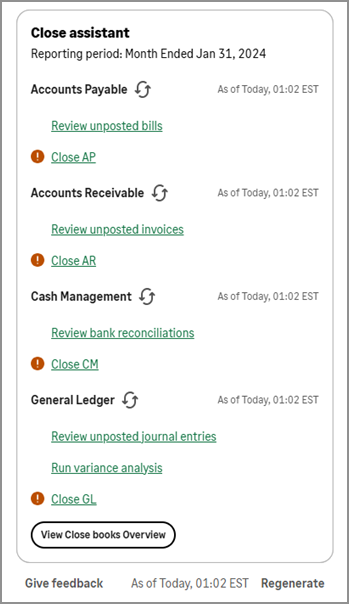
The month-end close remains one of the most demanding responsibilities for finance teams. Sage AI supports the close process by monitoring tasks, identifying bottlenecks, tracking progress, and flagging issues before they become delays.
Benefits include:
- Faster close cycles
- Improved accountability
- Reduced manual coordination
- Greater confidence in financial reporting
Read more on how Sage Intacct enables moving towards a continuous close, not a time-intensive month-end process in our article here.
Discover AI-Powered Sage Intacct with Acuity24
Acuity24 specialise in helping businesses implement and utilise Sage Intacct to streamline processes and improve efficiency as they grow.
We are an award winning Sage Business Partner, recognised for our innovative service delivery and support. As a member of the Sage Centurions Club, we’ve helped well over 100 customers migrate to Sage Intacct while providing fixed price services and unlimited support options to suit specific business needs.
Find out how we’ve helped customers across a variety of sectors in some of our Customer Case Studies.
Arrange an introductory call here to explore Intacct’s potential for your business or arrange a demo.